Silent monopile installation at Ecowende
SILENT XXL MONOPILE INSTALLATION AT ECOWENDE
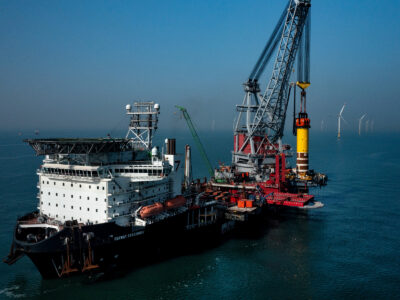
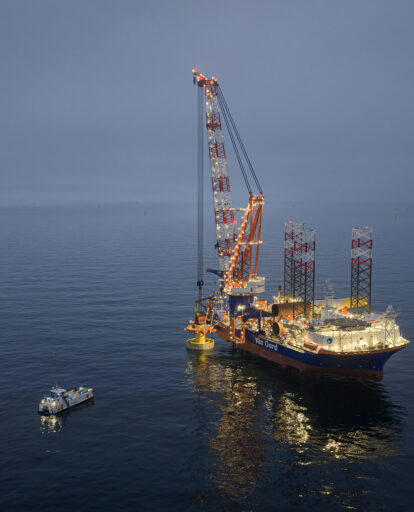
In 2026, CAPE Holland’s Vibro Lifting Tool – the CAPE VLT-640 Quad – helped install the monopile foundations for Ecowende’s Hollandse Kust West, set to become the most ecological offshore wind farm built to date. At the heart of the campaign sat a six-pile demonstration in some of the hardest ground in the Dutch North Sea: three monopiles driven with the CAPE VLT in combination with an impact hammer, and three with the CAPE VLT supported by jetting. On Wednesday 1 April 2026, that combination reached full target penetration for the first time ever at commercial scale – a milestone for silent, low-impact XXL monopile installation.
Ecowende – a joint venture between Shell, Eneco and Chubu – is building Hollandse Kust West (plot VI) around 53 kilometres off the Dutch coast near IJmuiden. Its 52 Vestas V236-15.0 MW turbines add up to roughly 760 megawatts, enough to green about three per cent of Dutch electricity demand. But capacity was never the whole story. Designed as the Netherlands’ first nature-inclusive wind farm, the project weaves ecology into every decision: a bird corridor through the layout, widely spaced turbines, raised hub heights, bird and bat detection, and even a handful of turbines carrying a single red-painted blade to test whether it helps birds see the rotor. Cutting the underwater noise of pile installation – and its impact on marine mammals, fish, birds and bats – is a central part of that ambition.
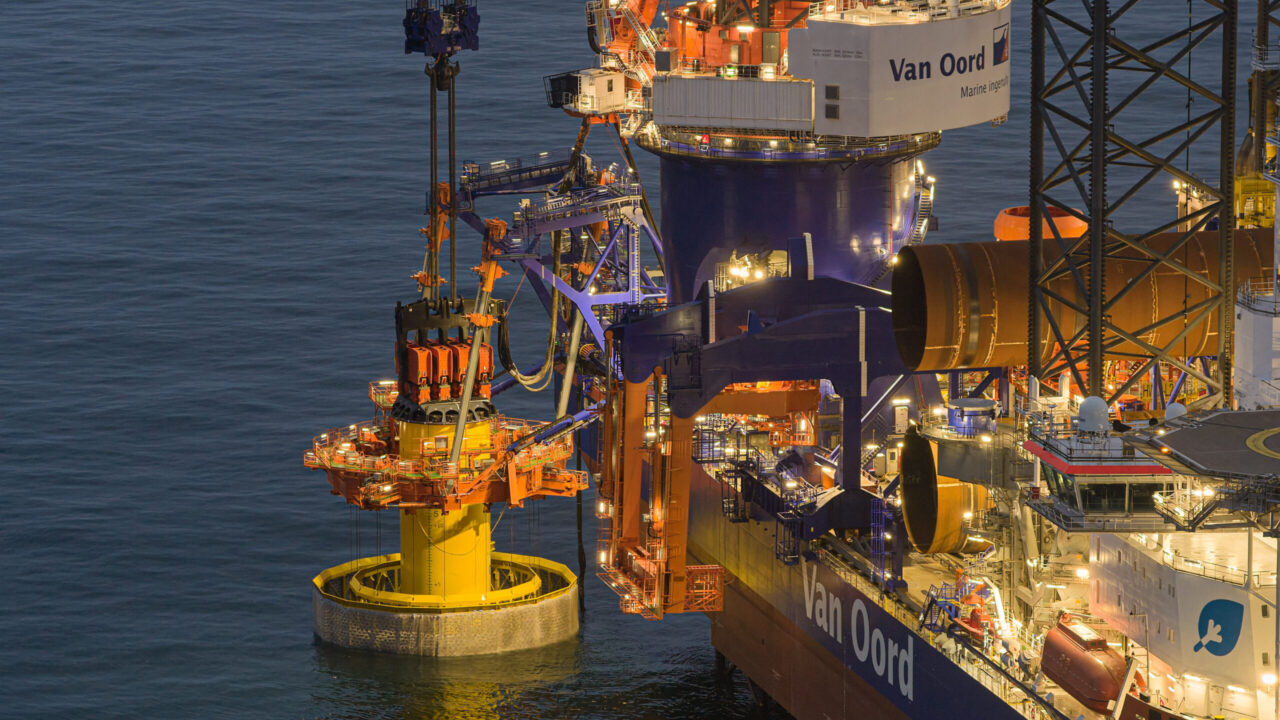
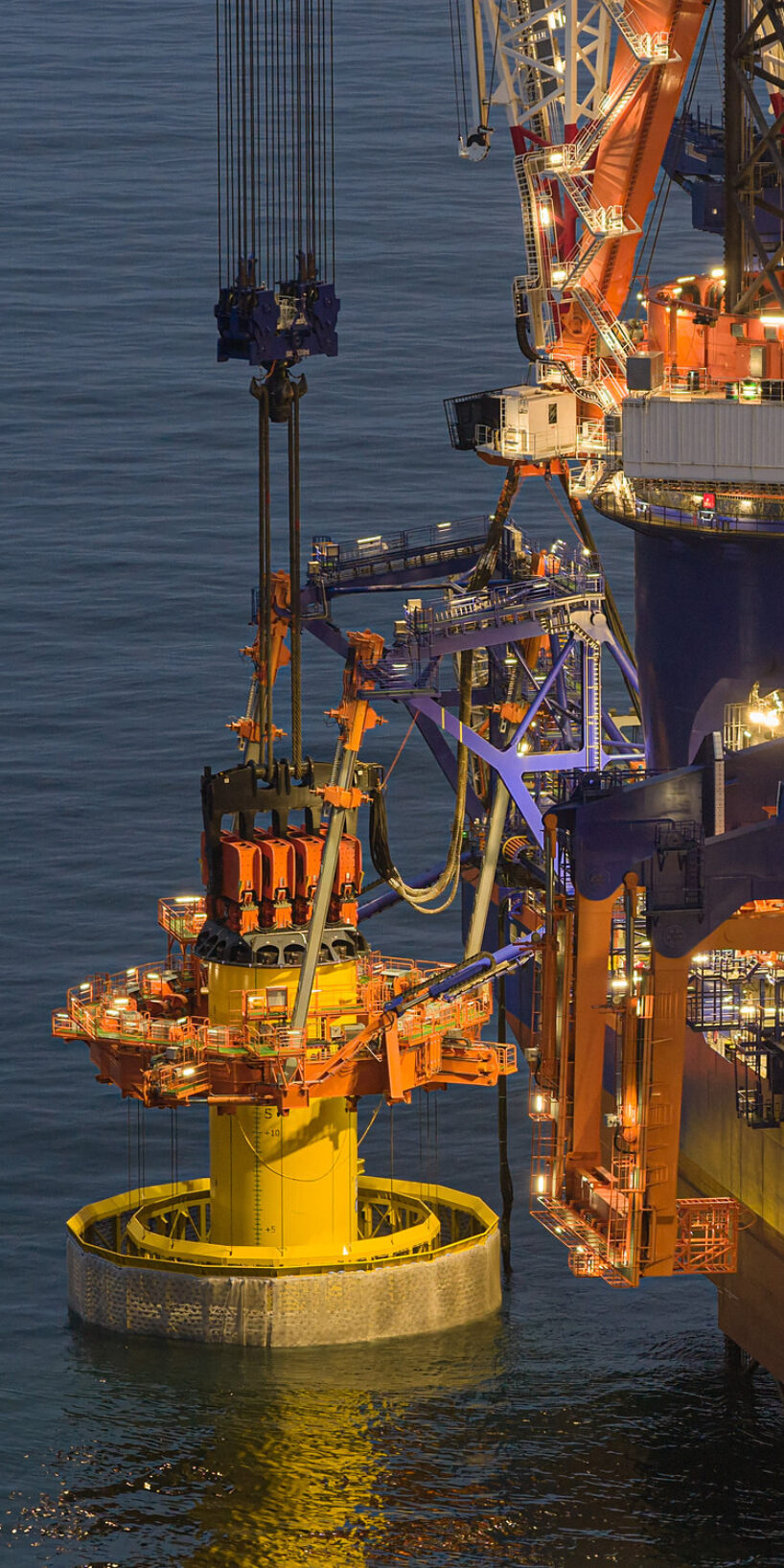
Where conventional monopile installation relies on a hydraulic impact hammer, the CAPE VLT drives piles with vibration. Vertical vibrations temporarily reduce the resistance of the surrounding soil, so the monopile settles largely under its own weight. The forces transmitted into the steel are far lower than under hammering – and so is the sound radiated into the water. For a project built around minimising ecological impact, that reduction in underwater noise is decisive: it is one of the innovations that helped secure the Ecowende permit in the first place.
Within the wider foundation scope, six piles formed a dedicated demonstration. Three were installed with the CAPE VLT in combination with an impact hammer. Three used an innovative combination – the CAPE VLT supported by GBM Works’ Vibrojet® – in which controlled water jets inside the monopile fluidise the soil and lower installation resistance even further. It was the first time Vibro and Vibrojet® had been applied together on foundations of this scale, and the goal was ambitious: to drive the piles deeper than Vibro alone can reach, ideally all the way to final penetration without ever picking up a hammer.
For CAPE Holland, the real prize is data. Vibro pile driving is a proven method – but understanding exactly how a full-scale monopile behaves under vibration in the North Sea is what turns a proven method into a precise, predictable and controllable one. Throughout the campaign the team focused on four questions: how deep the pile can be driven (driveability); how the pile itself behaves, and the motions and stresses it experiences; how the vessel and crane respond to the load; and how much underwater noise the process emits at every stage. Every pile added detail to the picture.
Hollandse Kust West was no random choice of proving ground. The seabed here is dominated by dense sand layers that make it one of the toughest places to drive a pile anywhere in the Dutch sector of the North Sea. That difficulty is precisely the point: if Vibro and Vibrojet® installation can reach target depth in ground like this, it can work at a great many easier locations. Proving the technique in the hardest conditions is what makes the result matter for the wider industry.
On Wednesday 1 April 2026, the proof arrived. For the first time ever, a commercial Vibrojet® monopile was driven to full target depth. Across the three jetting-supported foundations, the combined method reached the required penetration – delivered on a tight schedule, in dense sand, and without the acoustic punch of impact driving, which can radiate sound of around 200 dB re 1 µPa at 750 metres into the sea. Reaching target depth this way, at this scale, had never been done commercially before.
Marc van Rooijen, Chief Commercial Officer at CAPE Holland, called the result particularly significant given the hard seabed conditions, and said the campaign shows that “ecological and efficient can go hand in hand”.
The value of the campaign reaches far beyond these six piles. The data gathered during the Vibro and Vibrojet® installations will feed and validate predictive models for underwater sound and pile behaviour – models that can support the wider adoption of low-noise installation across offshore wind. Ecowende will share the insights with the broader offshore wind community, and CAPE Holland will carry the learnings into future projects: more precise, more controlled and quieter, campaign after campaign.
Hollandse Kust West is more than a wind farm. It is proof that the offshore wind industry is willing to learn, to share and to look ahead – towards a North Sea where energy and nature go hand in hand.
Find more project details below or contact Dick van Wijngaarden for more information.

Application details
Offshore wind turbines
XXL monopiles
26-30m
To final penetration
PILE DETAILS
Flanged monopiles
72.45 – 83.40m
1,500Te
7.50m
8.80-9.30m
6-pile demonstration
PROJECT DETAILS
Dec ’25 – Apr ’26
North Sea
The Netherlands
Approx. 53 km off IJmuiden
Offshore Renewables
Offshore wind turbine (Vestas V236-15.0 MW)
Ecowende (Shell, Eneco, Chubu)
Van Oord
Offshore wind installation vessel
Boreas, Van Oord
Dynamic Positioning

CAPE VLT-640

CAPE VLT-640 Quad
2,560kgm
3,000t
GBM Works Vibrojet®

vibro
lifting
technology
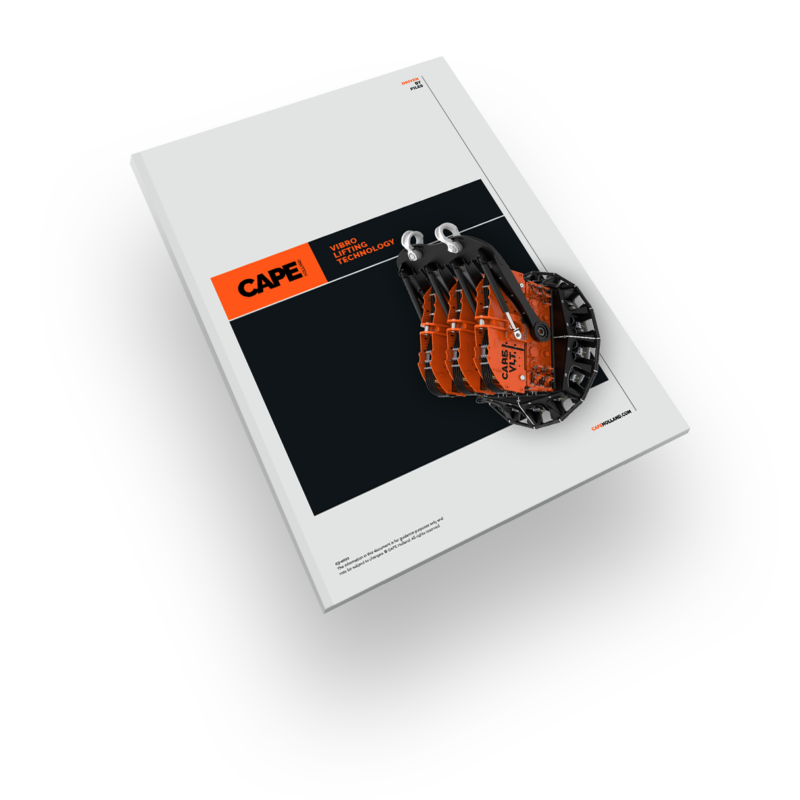
Discover how its unique features will uplift your next project; download the vibro lifting technology guide.